Over the past few years, our Newberg community has faced significant challenges—from disruptions in our schools to growing division and distrust among neighbors due to political polarity. Despite these hardships, we’ve also seen the incredible resilience of our community: people coming together to support one another, advocate for children and families, and rebuild trust through dialogue and shared action.
Now, we face a variety of new challenges. Recent federal funding cuts are creating real gaps in essential services—especially in areas like health care, education, and community support. These will create gaps in services that will have a direct impact on our neighbors, our schools, and the most vulnerable among us.
Rather than give in to discouragement, we believe this is a moment to come together with renewed purpose. We are committed to working across differences to ensure that our community continues to thrive. That means listening to one another, identifying where needs are greatest, and finding creative, compassionate solutions—together.
Our values are rooted in our faith and in the belief that every person deserves dignity, care, and opportunity. We are inspired by the legacy of Newberg’s Quaker founders and the many people who have worked tirelessly to make this a place of welcome and hope. We believe in the power of community to rise above division and meet challenges with courage and grace.
When we launched this group in 2023, our goal was focused on overcoming challenges that had befallen our schools and our children’s education. We told the stories of our town—stories that reflect the humanity, strength, and spirit of our neighbors and helped drive the changes to support the values of the majority of our community. Today, a mission that supports unity and the stories of our community feels more important than ever. By lifting up the voices of those affected by change, we hope to inspire action rooted in empathy and shared responsibility.
Let’s continue building a Newberg where everyone belongs, where every child is supported, and where we face the future not with fear, but with faith in one another.
Our Mission Statement
We are a collective of local writers dedicated to fostering unity and compassion in our community. Through thoughtful storytelling and clear communication, we shine a light on the events, challenges, and needs that shape our shared lives. By informing our neighbors and amplifying local voices, we aim to inspire connection, encourage action, and build a stronger, more caring community—together.
*Please contact us if you have a story you’d like to share or a topic you’d like us to explore. This is our old email, being used for a new, broader purpose: betternsdschoolboard@gmail.com
Federal retrenchments in health, education, and family support are leaving states to fill widening gaps. Cuts to Medicaid, narrowed Title IX protections, stagnant childcare investments, and uncertainty around reproductive rights all raise the stakes for Oregon families.
Women and children often bear the brunt, but fathers, caregivers, and communities as a whole are also affected. Oregon must respond boldly with equitable healthcare, family care, childcare, and educational support that shields every household—especially the nearly 70% of Oregonians earning under $100,000—from destabilization.
Healthcare for all Oregonians: Building Toward Universal Coverage
In 2022, Oregonians approved Measure 111, making health care a constitutional right. In 2023, SB 1089 created the Universal Health Plan Governance Board (UHPGB) to design a comprehensive plan for delivering affordable, equitable care. By 2026, lawmakers will review proposals to unify coverage and financing.
Oregon already operates OHP Bridge, providing premium-free coverage for adults who are at 138–200% of the federal poverty level. Pairing this with federal 1115 Medicaid waivers and 1332 reinsurance mechanisms can channel federal funds into a single, sustainable system. Lessons from Colorado, Washington, and Massachusetts show that expanding coverage is possible, but only if cost growth is disciplined and affordability benchmarks are enforced (Colorado Health Institute, 2024; Massachusetts Health Policy Commission, 2023; Washington Health Benefit Exchange, 2024).
To make this more than an insurance program, Oregon should reward providers for better health outcomes—like improved chronic disease management, widely adopted preventive care, and reduced avoidable hospitalizations—and offer Oregon cities incentives for providing and funding community clinic spaces and support for new medical and nursing graduates in primary care roles.
Family Care: Paid Leave That Works for Everyone
Oregon’s Paid Family & Medical Leave (PFML) program now guarantees up to 12 weeks of paid leave (14 for pregnancy-related needs). Since launching in 2023, it has delivered over $1 billion in benefits to more than 150,000 people. Yet delays in processing and limited awareness—especially among fathers, self-employed workers, and small business employees—undermine its impact.
To strengthen PFML, Oregon should:
Streamline applications and improve processing for faster benefit delivery.
Expand outreach to fathers and caregivers in non-traditional roles.
Integrate PFML with universal health coverage so families’ wages and health needs are jointly protected.
Childcare: Affordability as an Economic Imperative
Oregon has the highest infant care costs in the nation—nearly $18,000–$19,000 annually. Public investments have reduced “childcare deserts” from 27 counties in 2018 to just 9 in 2025. But demand still far outpaces supply.
Legislation such as SB 5514 ($225M for subsidies), passed in July, 2025, and HB 2593 (still in Committee; goal of bill is to reduce waitlists) should be implemented. State leaders can also expand support for childcare businesses and explore municipal childcare grants for cities that invest in facilities, or workforce training.
Education: Schools as the Core of Family Safety Nets
Schools are more than a place to learn—they are frontlines for child safety, mental health, and family resources. Narrowed federal Title IX protections risk undermining these roles. Oregon should maintain strong state-level Title IX standards that protect all students, including boys who underreport harassment and girls who face systemic barriers (Oregon Department of Education, Title IX Guidance, 2024).
Education funding should also be coupled with child wellness services in each community:
Expand SafeOregon tip lines and mental health counselors in schools.
Fund afterschool and early-learning programs as child-protection tools.
Encourage partnerships between schools, healthcare providers, and social services so families can access multiple supports under one roof.
A Unified Vision for all Oregon Families
Oregon has a historic opportunity to weave together universal healthcare, strong family leave, affordable childcare, and robust educational supports into a cohesive safety net. Doing so will not only protect low to average income households from federal shortfalls, but also improve long-term community resilience.
The path forward is clear:
Guarantee healthcare as a right—and make it affordable.
Strengthen PFML so all parents and caregivers can use it.
Cut childcare costs and expand supply statewide.
Keep schools as safe, equitable anchors for every child.
When the federal government falters, Oregon must stand tall. By building systems that value health, caregiving, and education for everyone in our communities, Oregon can ensure her families have the stability to thrive.
“They have masks on their faces. You can’t tell who they are,” said Innovation Law Lab’s (ILL) Communications Manager Victor Romero Hernandez of ICE agents in recent months. “ICE has become a lot more violent and aggressive, and a lot less transparent,” he told me.
Romero Hernandez says detentions used to be much more reliably tracked than they are currently. On the US Immigration and Customs Enforcement website, a search engine called “The Online Detainee Locator” (ODLS) is displayed. An individual believed to be in ICE custody can be searched on the system using the individual’s Alien Registration Number or alternately, using first name, last name, and country of birth.
On the website, ICE notes that “[f]or security reasons, ODLS does not provide information about transfers that are planned or in progress.” However, “Once a person is transferred and booked into another ICE detention facility, ODLS will be updated with that information.“
According to Romero Hernandez, the information about detainee location that ICE says it provides is not consistently made available. “It used to be that they [ICE] would detain somebody and then they would appear on the ICE identifier,” he said. “Now, not as often.”
Innovation Law Lab is a Portland based immigrant advocacy organization, with “team members in Arizona, California, Florida, Georgia, Illinois, Texas, Washington, and Mexico,” its website states.
The organization was founded in response to the detention of Central American migrants at covert facilities near Artesia, New Mexico over a decade ago. These were “secret detention facilities in very remote areas,” said Romero Hernandez.
Cell and wifi service were limited or nonexistent in these areas, so Innovation Law Lab “built a software system to support immigration attorneys” where they had previously been hindered in their work for lack of access.
Now, the work of Innovation Law Lab is three-pronged. “[W]e use the law, technology, and organizing to advance the immigration movement,” Romero Hernandez said.
Lately, he says, everyone’s workload at ILL has “gotten a lot heavier.” With an increase in detentions, he says their attorneys have had to respond very quickly to a lot of cases. Meanwhile, those working in advocacy for the organization have been focused on lobbying to maintain free and low-cost immigration services in Oregon through the Equity Corps of Oregon.
“As a formerly undocumented person, I can speak to how hard it is to stay on top of rent and food on top of trying to pay attorneys and legal experts,” Romero Hernandez said.
In recent months, immigration proceedings at courthouses have attracted ICE agents and resulted in detentions, he told me. When ICE teams detain individuals they often “don’t have identification,” he stated.
“We think about these as kidnappings,” Romero Hernandez continued. “It’s […] like kidnapping, where people are snatched off the streets in unmarked vans.”
*Shared with permission from a Yamhill county Substack writer
Federal retrenchments in health, education, and family support are leaving states to fill widening gaps. Cuts to Medicaid, narrowed Title IX protections, stagnant childcare investments, and uncertainty around reproductive rights all raise the stakes for Oregon families.
Women and children often bear the brunt, but fathers, caregivers, and communities as a whole are also affected. Oregon must respond boldly with equitable healthcare, family care, childcare, and educational support that shields every household—especially the nearly 70% of Oregonians earning under $100,000—from destabilization.
Healthcare for all Oregonians: Building Toward Universal Coverage
In 2022, Oregonians approved Measure 111, making health care a constitutional right. In 2023, SB 1089 created the Universal Health Plan Governance Board (UHPGB) to design a comprehensive plan for delivering affordable, equitable care. By 2026, lawmakers will review proposals to unify coverage and financing.
Oregon already operates OHP Bridge, providing premium-free coverage for adults who are at 138–200% of the federal poverty level. Pairing this with federal 1115 Medicaid waivers and 1332 reinsurance mechanisms can channel federal funds into a single, sustainable system. Lessons from Colorado, Washington, and Massachusetts show that expanding coverage is possible, but only if cost growth is disciplined and affordability benchmarks are enforced (Colorado Health Institute, 2024; Massachusetts Health Policy Commission, 2023; Washington Health Benefit Exchange, 2024).
To make this more than an insurance program, Oregon should reward providers for better health outcomes—like improved chronic disease management, widely adopted preventive care, and reduced avoidable hospitalizations—and offer Oregon cities incentives for providing and funding community clinic spaces and support for new medical and nursing graduates in primary care roles.
Family Care: Paid Leave That Works for Everyone
Oregon’s Paid Family & Medical Leave (PFML) program now guarantees up to 12 weeks of paid leave (14 for pregnancy-related needs). Since launching in 2023, it has delivered over $1 billion in benefits to more than 150,000 people. Yet delays in processing and limited awareness—especially among fathers, self-employed workers, and small business employees—undermine its impact.
To strengthen PFML, Oregon should:
Streamline applications and improve processing for faster benefit delivery.
Expand outreach to fathers and caregivers in non-traditional roles.
Integrate PFML with universal health coverage so families’ wages and health needs are jointly protected.
Childcare: Affordability as an Economic Imperative
Oregon has the highest infant care costs in the nation—nearly $18,000–$19,000 annually. Public investments have reduced “childcare deserts” from 27 counties in 2018 to just 9 in 2025. But demand still far outpaces supply.
Legislation such as SB 5514 ($225M for subsidies), passed in July, 2025, and HB 2593 (still in Committee; goal of bill is to reduce waitlists) should be implemented. State leaders can also expand support for childcare businesses and explore municipal childcare grants for cities that invest in facilities, or workforce training.
Education: Schools as the Core of Family Safety Nets
Schools are more than a place to learn—they are frontlines for child safety, mental health, and family resources. Narrowed federal Title IX protections risk undermining these roles. Oregon should maintain strong state-level Title IX standards that protect all students, including boys who underreport harassment and girls who face systemic barriers (Oregon Department of Education, Title IX Guidance, 2024).
Education funding should also be coupled with child wellness services in each community:
Expand SafeOregon tip lines and mental health counselors in schools.
Fund afterschool and early-learning programs as child-protection tools.
Encourage partnerships between schools, healthcare providers, and social services so families can access multiple supports under one roof.
A Unified Vision for all Oregon Families
Oregon has a historic opportunity to weave together universal healthcare, strong family leave, affordable childcare, and robust educational supports into a cohesive safety net. Doing so will not only protect low to average income households from federal shortfalls, but also improve long-term community resilience.
The path forward is clear:
Guarantee healthcare as a right—and make it affordable.
Strengthen PFML so all parents and caregivers can use it.
Cut childcare costs and expand supply statewide.
Keep schools as safe, equitable anchors for every child.
When the federal government falters, Oregon must stand tall. By building systems that value health, caregiving, and education for everyone in our communities, Oregon can ensure her families have the stability to thrive.
May every being on earth be free from suffering and oppression. May they live in health, in safety, and in happiness.
May each person be infused with divine light and love— So deeply filled with love that it flows into action: A love expressed through goodness, through service, through blessing others.
May patience and kindness rise to replace anger and vitriol. May peace and contentment dissolve avarice, envy, and jealousy. May a love of truth and a reverence for wisdom Replace deception, lies, and propaganda.
May the spirit of community and interdependence Outshine the illusion of individualism and selfishness. May a sacred sense of stewardship guide our care For the land, the air, the waters, and the sky above.
May we replace excess with gratitude— Appreciating what is enough, and sharing freely.
May those we entrust with leadership Govern with wisdom, integrity, and compassion for all.
May cooperation replace unhealthy competition, and greed replaced by generosity.
May goodness overcome cruelty. May mercy replace judgment.
Newberg City Council recently approved a large amount of grant money from their construction excise tax fundsto a new organization. A Newberg resident is asking the council to reconsider. This is the letter she sent to the mayor and the council.
Dear Newberg City Mayor & Council Members,
I am writing to ask the council to reconsider its recent decision to fund the SPARK housing program with $742,934.52 from the CET fund. I am extremely disappointed that the council decided to ignore:
the Affordable Housing Committee’s recommendation,
the fact that the SPARK program didn’t even meet the criteria to be eligible for the funds,
the underlying classism and patronizing assumptions of the whole SPARK program,
some very basic money facts, and
the fact that the SPARK program won’t help the families in our community that most need housing assistance.
The Affordable Housing Committee took seriously their duty to review applications objectively and plainly laid out its reasons for rejecting SPARK. The committee’s decision was, quite simply, based on SPARK not meeting the objective criteria that ALL applicants were judged by. (I am sorry that Mayor Rosacker feels that those criteria favor 501(c)3 organizations, but perhaps there’s a reason for that: other organizations have some legitimacy AND more than just the “concept of a plan.”) I question whether other organizations would have received funding if they, too, had not even met the basic criteria. While the mayor publicly recused himself from the discussion/decision of the council at the meeting, the whole thing just smells wrong.
Furthermore, in the same meeting, City Manager Will Worthey recommended recognizing Newsberg as a media outlet based on the established criteria and scoring system. Yet when it came to spending a great deal of money, the council ignored the established criteria. WHY would the council accept the current scoring criteria for something far less significant, but shrug off the affordable housing committee’s recommendation, which was based on established objective criteria?
Being a retired nurse, former City of Newberg firefighter/paramedic and a college graduate, I have nothing against the teachers, nurses, and firefighters that SPARK identified as their target demographic. I understand the challenges of commuting to work as I commuted to work at Providence St. Vincent and Kaiser Westside for years. However, what the council fails to recognize is that the aforementioned demographic generally HAS housing stability. It may not be in Newberg, but these professionals are housed.
You know who generally doesn’t have stable or affordable housing? Minimum wage earners, hospitality workers, grocery store clerks, caregivers, seasonal workers, or disabled folks. These folks also work in Newberg and would probably like to be able to live in Newberg. Living where they work is especially important when transportation is often an expense they struggle with as well. Unfortunately, it appears that this is a demographic that Mayor Rosacker and the rest of the SPARK board find less desirable or worthy to help. This is classism, hidden in plain sight.
Beyond the classism, though, is the patronizing assumption that the reason people can’t afford housing in Newberg is because they are bad with money and need financial education (48 months of financial education, for crying out loud!) People can’t afford houses in Newberg because all that is being built is $400,000+ homes and because everyday things cost more, thanks to tariffs, corporate greed, and food rotting in the fields with no one to pick it.
More concerning is the fact that the program is not fully fleshed out, and while the SPARK website recently deleted references to “relational, emotional, and spiritual development”, we have no idea exactly what ideological education program participants would have to agree to participate in for 48 months in order to have a chance at a grant for a down payment. If the program proves to be too patronizing or onerous, the participants would be forced to leave and then have to find new housing. The program’s stated desire to avoid the tenant/landlord relationship would further expose participants to unfair risk from waiving important tenant rights they would have had in a traditional housing situation.
Lastly, by doing some basic calculations, I found that this program will NOT be nearly as helpful as it claims to be. Using a basic mortgage calculator, I calculated that the average Newberg home priced at $426,600 would require a down payment of $85,320 (20%). The SPARK program would allow the participant to apply for a grant that averages around $38,400 (figuring a program contribution of $800/month for 48 months.) This is not quite half of the necessary down payment.
Additionally, the monthly mortgage payment for the sample home would be $2215.52.
Households making 80% of median income make $72,800 a year or $6066.67/month before taxes or likely around $4,000/month take home pay.
Households making 50% of median income make $45,500 a year or $3791.67/month before taxes or likely around $2900/month take home pay.
A person working 40 hours per week at $17/hour makes $35,360/year or $2946.67/month before taxes or likely around $2300/month take home pay
This means that SPARK’s stated target demographic (who usually already have housing stability before entering the program) would be looking at purchasing a home whose mortgage payment is more than half of their monthly income. Poorer households (that struggle with housing stability and may be unhoused) will find that a mortgage payment would be most, if not all, of their monthly take-home pay. The poorer folks would also struggle to afford even the “market rate” rent that the SPARK program would require. On top of all of this, none of these income levels would qualify for a mortgage for a $426,600 home, unless they get a really questionable and predatory lender.
Bottom line, the decision to award the CET money to SPARK does not bear up under further examination. The program won’t help the Newberg residents and workers that need help the most and it has all the appearance of being a classist, patronizing, ideologically based way to help a “more deserving” group of people. The math doesn’t add up. Finally, there isn’t even a solid program to evaluate. The affordable housing committee had it right. The city council needs to reverse this decision.
A well-informed and deeply invested community is central to the work of Brandon Slyter and Nick Konan, both running in this May’s election for Chehalem Park and Recreation District board. Both men are campaigning to serve on the board because they see value and promise in the parks and public spaces available to Newberg/Dundee residents.
They hope that their voters will learn all they can about some of our community’s biggest assets. Its flourishing park system. Its state-of-the art recreational center, and multiple sports fields that are used year round. Its thriving pickleball club, as well as multi-generational activities too numerous to mention here.
Brandon and Nick believe that what is known about CPRD’s decisions can sometimes seem a bit unclear, and that community members aren’t always informed about what CPRD is doing, nor what CPRD can offer the community. They are campaigning with the intent to provide more transparency and more communication in the board’s actions, which will translate into more accountability about how resources are allocated by the board.
“I don’t feel like the community knows what CPRD is doing unless they go to all the meetings,” Brandon said at a Saturday meeting. “And even then, there’s a lot of questions. People don’t know where their tax dollars are going. They’re not educated on what parks we even have sometimes. They could see how amazing our district is if the district put in that effort to tell everybody.”
As a parent and long-time Newberg resident, Brandon knows first hand how communication can make a difference. He cites a land exchange in his neighborhood, and the relinquishing of land in Friends Park to a private owner, as an example of when communication might have helped. According to Brandon, many in his neighborhood were “confused and frustrated” and did not know what was going on. “Nobody was communicating with us,” he said.
Brandon continued, saying “I took it upon myself to do the research, to appeal the county lot line adjustment to force people to the table to say, ‘What’s going on? How can we work together and understand what’s happening?’”
“After we learned some details, we decided that as a neighborhood we wanted CPRD to hear our voice…We don’t want the lot line adjustment to happen,” Brandon said. He emphasized that people want their walking path to be safe from roads and they want shade from the trees that are at risk.
All this could have been avoided if communication had been better from the start. “So for me what’s important is that CPRD talks to the neighbors,” Brandon said, explaining that it felt like CPRD did the bare minimum required for communicating. He would like to see much more robust engagement with the community.
One idea Brandon has proposed is QR codes available at every public park, directing users to a website with more robust information. He sees this as a simple way the district could communicate with residents, letting them know how their parks are being maintained, and–more specifically–how their tax dollars are being spent.
Brandon already has substantial investment in his hometown. He serves on the CPRD Budget Committee, and has been certified through a district board training program. According to the Oregon Voters’ Pamphlet, Brandon has a “decade of experience leading disaster relief teams and managing complex logistics,” and is running on the principles of “transparent decision-making, supporting the dedicated staff, and prioritizing the long-term sustainability of our parks and programs.”
Nick has also been involved in the Newberg/Dundee community, and has a long history of working with parks and recreation districts, starting with his first job as a park technician in the Beaverton area. Now, he serves on the Pickleball Advisory Committee, and–like Brandon–attends CPRD meetings to learn more about the board’s work.
He is convinced that public spaces have value: that they bring people together, and are important investments for the physical and mental health of those in communities. And it’s for that reason that Nick believes the board should communicate clearly with its constituents about decisions being made that can enhance their health–or not.
“I just in some ways felt that decisions were not being made for the masses,” Nick said of the current board. “It’s critical that the board should benefit as many people as we can with the decisions that are made.”
“This motivated me to want to be a part of CPRD and help set policy that ensures that our park district is going to be available and accessible to all of our citizens,” Nick added. “The money CPRD is spending is coming from community members, from all of our tax dollars, and decisions of how our tax dollars are being spent need to be thought through and need to be really intentional.”
Fundamentally, both men are running because they care about our parks and care about our kids, and about how local resources can be best used to serve the entire community.
“Being present in a local, non-partisan park position is important,” Brandon said, noting that this election might be decided by a few votes. Making informed decisions about the future of our community’s public spaces is important for Newberg and Dundee to thrive.
“However, after an extensive investigation, I found that systems to monitor the district’s finances were either non-existent or were unsophisticated and ineffective in achieving the desired outcome.” Independent Investigator Dave Novotney, Ph.D.
A damning 56-page investigation report was obtained by Newberg Neighbors and reveals that former Newberg School District Superintendent Dr. Steve Phillips failed to monitor the budget, resulting in an $8 million deficit. He also used racist language and misrepresented the district’s compliance with state standards. The report, prepared by independent investigator Dave Novotney, Ph.D., substantiates four of seven allegations against Phillips during his tenure leading a district beset by years of controversy.
Dr. Novotney was also briefly the interim superintendent prior to Dr. Phillips, when then-board chair Dave Brown and three other board members fired Dr. Joe Morelock with no plan for a replacement. At the time, Novotney provided his services for free as the superintendent of the Willamette Educational School District, of which Newberg is a part. Upon his retirement, he became an independent investigator.
The investigation, which included interviews with 27 district employees and administrators, paints a picture of a superintendent who held informal “pop-in” meetings instead of implementing proper financial oversight, referred to students and staff using racist terms in private conversations, and told staff to report compliance with state standards even when programs fell short – because “nobody actually reports out of compliance.”
We are expecting further information from our records request. This report, which is redacted to protect the identities of those who were interviewed over the course of the investigation, is the first.
Newberg Neighbors has taken the liberty of creating a Cliff’s Notes version for public consumption.
Allegation 1: Did Dr. Phillips fail to provide adequate oversight of the budget?
The allegation was substantiated, with 4 specific duties contained within school board policies CB and CBA were cited that demonstrated Dr. Phillips’ culpability for the devastating budget fiasco. Furthermore, as Dr. Novotney is a former superintendent himself, he had specific knowledge of the responsibilities of a superintendent and the budgeting process and found Phillips to be lacking in his fiduciary responsibilities.
Specifically, the district lacked basic systems with which to monitor the budget, did not implement a practice known as “budget blocking” in the district’s finance software that would have prevented the overspending responsible for the budget deficit, and did not grant administrators access to monitor or view their departments’ budgets. Despite Dr. Phillips’ claims that he isn’t responsible for the mess made of the district’s budget, Board Policy very clearly states that, while the superintendent can delegate tasks to others, they are not relieved from the responsibility of actions taken under delegation.
Allegation 2: Did Dr. Phillips use racist and discriminatory language during private meetings?
The allegation was substantiated, with two standards in the employee handbook and two standards in NDPS board policy CBA cited to have been violated. Dr. Phillips referred to Caucasian kids as “whities,” Hispanic students as “brownies” and LGBTQ students as “gays and weirdos” in multiple instances with two separate people, one of whom Dr. Phillips assumed would be friendly to his views. In Dr. Phillips’ interview, he expressed frustration at a perceived lack of loyalty among administration ranks, seemingly expecting to be protected at all costs by the principals who worked beneath him. Dr. Phillips also claimed ODE wanted students to be referred to as white kids and brown kids. This item is potentially reportable to TSPC.
Allegation 3: Did Dr. Phillips mislead ODE, the NDPS Board of Directors, and the community at large about the district’s full compliance with Division 22 standards in fall of 2023?
The allegation was substantiated. NDPS board policies CM and CBA were cited to have been violated, as well as two standards in the employee handbook. This item is potentially reportable to TSPC.
Allegation 4: Did Dr. Phillips fail to adhere to board policy regarding Reductions in Force (RIFs) in June of 2024?
This allegation was unsubstantiated, with specific board policy cited that demonstrated why this was an unfounded claim. Specifically, the June RIFs were for classified and non-represented staff, two populations who don’t require Board of Directors action before the RIF process can begin.
Allegation 5: Did Dr. Phillips fail to properly implement administrator evaluations consistent with TSPC standards and Board Policy CCG?
This allegation was substantiated and was fairly cut-and-dried. However, Dr. Phillips claimed administrators in Newberg had never been evaluated by TSPC standards, which was easily found to be untrue as TSPC standards were used in the 2021-22 school year by Karen Pugsley, who was Admin on Special Assignment at the time. The evaluation created by Dr. Phillips was merely a self-reflection.
Allegation 6: Did Dr. Phillips attempt to negatively impact the employment of Gregg Koskela?
This allegation was unsubstantiated, as the other superintendent in this equation seemed to understand the communication from Dr. Phillips to be a concern about whether Mr. Koskela was writing and posting on his blog during company time. It should be noted, however, that Dr. Novotney believes Dr. Phillips did make a significant error in judgment in contacting Mr. Koskela’s new boss.
Allegation 7 was specific to Dr. Phillips’ time in Jewell and the civil rights lawsuit filed last spring.
As the litigation is ongoing, a proper investigation was unable to be completed. However, Dr. Novotney noted in his report that Dr. Phillips promptly reported an inappropriate letter discovered in the classroom of the sex offender to the proper authorities.
We recommend reading the full report in its entirety. In early 2022, we had a superintendent candidate with the knowledge, experience, and reputation to lead a district of this size; yet the conservative school board majority chose a superintendent on administrative leave and under investigation at his then-current job, who was also forced out of his previous job due to the expression of racist views via the reposting of anti-undocumented immigrant sentiment on the social media platform X, formerly known as Twitter. Thus, none of what’s contained within the pages of the report should be a surprise to anyone who has been paying attention to school district business over the last four years.
It is clear Dr. Phillips was not hired because he was the best man for the job; rather, he was hired despite being unqualified for the job. His sole qualification was his political views, which closely matched those of the conservative board majority. Don’t take our word for it: one of the people interviewed stated Dr. Phillips referred to people unaligned with his political views as “commies.” This cronyism directly led to chaos, destruction, and heartbreak for our district and community which will take years to fully recover from.
It is our hope the community will remember this saga when it’s time for school board elections in May. Our next school board will be responsible for hiring a permanent superintendent for our district. It is imperative we continue the healing process by electing people with integrity who are committed to the non-partisan nature of the school board, so that a superintendent of good character who will lead this district with competence, professionalism, virtue, and accountability may be hired.
Your letter to your “Friends and Family,” published on multiple community social media sites, was the impetus for me to write this open letter to you. *By resigning suddenly, just four months shy of the end of your term, you were not good to your word and never responded to my request to meet with you despite multiple reasons for meeting.
You have been an enigma to me. Your words frequently sounded good, but your actions seldom matched your words. Despite writing to you numerous times while you were on the board, you never acknowledged that you had received or even read any of the emails I sent you. The last time I wrote to you, I requested a meeting, for you to listen to me, for me to listen to you. My letter mentioned several topics I wanted to discuss:
Finances. Specifically, your thoughts about who you believe is responsible for them and your understanding of what happened with Dr. Phillips.
The Superintendent. How you understood the role of Dr. Steven Phillips, his contract, and the role and contract of the deputy superintendent. Also, I wanted to know why the board approved a deputy superintendent contract, something that is not normally their job.
Your intent in the August 13, 2024 board meeting: A lot of what was said and asked about at that board meeting is deeply troubling to me. The disclosure that you reached out and spoke to two people on protected leave is the most serious from a legal perspective. I have agonized over whether to file a formal complaint about this incident. I have decided to hear you out and ask my questions before making that decision.
Your response to my request to meet and talk was curt, but I was pleased you responded! Here is what you said: “This response is to let you know that I have received your email. You have included many things for me to think about. Once I have had time to consider your request I will respond.”
Since you never did respond, instead quitting and posting a public letter, I have to assume this public letter is your response, so I shall respond in kind.
In 2008, I went back to work after mainly raising children for 15 years. I worked part-time for NOCAP (Newberg Off-Campus Alternative Program). Over a period of years, my eyes were opened to a part of Newberg I didn’t know existed.
God was working in my life. As the reality grew that here in Newberg there were many children growing up in poverty, or broken homes, or homes rocked by drug addiction, abandonment, mental health issues and death, many of my biases were exposed and challenged. God, like he always is, was good. Co-workers were patient with me. Students were patient with me. God was patient with me.
My path with the Newberg School District was long and windy, but when I landed back at Catalyst (NOCAP renamed and in a beautiful new building-thank you Newberg!) in a job that used my Bachelor degree in sociology/social work, I had found both my passion and my calling. To quote Frederick Buechner about vocation, “The kind of work God usually calls you to is the kind of work (a) that you need most to do and (b) that the world most needs to have done.” I was doing meaningful work in my hometown with a diverse group of dedicated staff and students.
Those who followed developments in the district noticed that when you won the board election in 2021 (against a life-long conservative Christian, who also felt called to serve on the school board) you told people that big changes were coming. (The plan to fire Joe was already in place) For those of you who were paying close attention to the developments of the school board, you heard that Dave Brown, as the new chair said, “**Discovery has got to go.” We also heard Renee Powell regularly denigrate staff and spout that we were “indoctrinating” students. For those folks, it may not have been a surprise that I took a leave of absence, then resigned, so I could continue to speak truth and advocate for the students of the school district, specifically Catalyst.
I was very prayerful, and honestly believe the Lord called me to Catalyst, and then called me to leave Catalyst to continue being a voice for the marginalized students in Newberg. I was to continue partnering with God’s love and God’s work in the world.
Because of you firing, without cause, a skilled superintendent and your efforts to create school policies that would transform the environment into one that normalized and centered white nationalism and Christian nationalism, and making sure loyalists were in all positions, I was persecuted and my husband reassigned (sound familiar?).
District office staff received personal death threats and other personal threats on an almost daily basis; threats that often stated support for Dave Brown and the board. ***Carey Martell, who Dave Brown described as “doing more for the school district than anyone,” mailed an entire glossy flyer (funded by ?) full of smears and lies about my husband to the entire school district population.
Four community members, two of them teachers, were sued by four board members, including you. No, not one of them shared personal addresses or phone numbers of the four of you, or suggested that anyone harass you. They were desperately trying to figure out who you all would actually listen to. Your employers? Your pastors? In one case, a person was trying to get important information from a former team member to the appropriate person. Your suing actually seemed to be retaliation against the group of parents who sued the board for acting illegally.
Note: You lost your lawsuits, they won theirs.
Back to me and other staff members–losing our main income and the constant physical and financial threats created a tremendous amount of stress for me, my family, and a large number of school district staff. The staff members you sued left the district. The community members you sued left our community.
I am a strong woman who has no illusions that following God will be easy. Yet still, it was disheartening that my husband and I had to be subjected to such hatred. When you first started working with the new board, I was alarmed at how Renee Powell still spoke words of absolute certainty and shame to her fellow board members. You didn’t speak much, but sometimes when you spoke, it sounded good.
Your actions seldom matched your words however. Your votes were always in support of Renee and Dr. Phillips, even when things like that sweetheart deal contract that NEVER should have happened in the first place were on the table. During that process, you used a manipulative form of dehumanization as an analogy, saying the board was “holding a gun” to Phillips’ head. I think this was pure projection as Dave Brown and the rest of his board, including you, held the school district hostage with a completely hidden, sweetheart of a contract for Phillips. There was a stunning amount of lies and manipulation when that contract was brought to the light.
Still, after Renee moved, I was hopeful your sense of calling to the district and desire for good for the district, combined with the obvious effort every board member made to include you and treat you respectfully, would result in good for the district. We all watched as the district’s severe budget problems came to light. I hoped you would finally lay blame in the right place. After all, it is critical for school districts that the superintendent oversee the budget correctly.
Instead, I witnessed you blame anyone but Phillips and subsequently witnessed a lot of manipulation from you. To say your words and your body language/tone/voting did not match is an understatement. You spoke what I sincerely believe to be lies about the former chair of the school board, even though you should have known by then that Phillips would do anything, including lying, to save his own skin. You claim that you have witnessed “a high degree of dishonesty and manipulation, resulting in good people’s lives being turned upside down and their careers and reputations being destroyed”.
Hear me—-Dr. Phillips brought that on himself. He was largely without honor in the budget crisis. There was plenty of evidence present prior to you hiring him to know that Dr. Phillips, despite fitting the political profile you were looking for, was not a skilled superintendent. You brought him to our district anyway. You brought a high degree of dishonesty and manipulation. It resulted in good people’s lives being turned upside down and their careers and reputations being destroyed long before Dr. Phillips failed to oversee the budget.
When you resigned suddenly from the board, with no warning and no explanation, I figured the results of the investigation into Dr. Phillips were too painful. I was hopeful that the Lord, or one of his gifts, cognitive dissonance, had finally been acknowledged in your life. But no. Instead I read a letter full of enough grievances and blame to mask any Spirit of God speaking or cognitive dissonance that might have been showing up. It makes no sense that you resigned four months before your term was over because of “negativity, false accusations and miscarriages of justices.” By your telling, those have been present since the beginning of your term. I’m sticking with this being the way to avoid the cognitive dissonance created by Dr. Phillips’ actions and the independent investigation.
I feel incredibly fortunate that I was hired by Forest Grove to work at their alternative program and my husband was hired by a small district in the opposite direction, where he is their amazing communications director and now oversees bond work as well. Like many other former district employees who were forced out of jobs or experienced RIFs because of budget cuts, we have found meaningful work far from our homes. I look forward to becoming a new grandmother this year and many other things. I will be continuing to practice hope, to seek truth and justice, and to lean into joyful community. As my pastor said today when we gathered to worship, “We get to experience WITHNESS”— both with others and God. I have made long lasting and meaningful relationships because of these rocky years our school district has endured. ****I will never regret that.
God is great and His plans are perfect.
Elaine Koskela
Former employee of the Newberg School District
* “How many good people will be dissuaded from running if this garbage keeps up?” This statement, made by the person who posted your letter publicly, is another reason I was moved to write this open letter. I take heart in the fact that so many people in Newberg and Dundee are paying attention and have shown a willingness to hold our public officials accountable, even at great personal cost. It’s another thing I will never regret; a whole lot of people were very interested in what was happening in our public schools and many, many people have stepped up. By all means, if you are a person who believes that public education is the best way of making sure we educate all our children, if you believe that all our children are worth educating, if you are passionate about working together with other passionate people, if you are willing to listen and learn, and speak your knowledge, and follow the rules, please get involved! You will find amazing people to work alongside.
**Discovery is an amazing six-week program that is successfully used in many types of alternative schools to teach study skills, to allow new students to get to know each other and the school, and to learn the culture and structures of the school, including the main tenant that everyone is treated with dignity and respect. I don’t think Dave had a clue what Discovery was when he declared, waaaay out of his lane as board chair, that “Discovery has to go”.
***I cannot make myself look up the exact quote, but the italics are quite close.
****Using your format and occasionally your actual language to speak my truth is intentional.
Like the rest of the country, Newberg and Yamhill County have a unique opportunity to turn the page on controlling, grievance-filled politics by rejecting politicians who have refused to work with any “outsiders,” taking their positions as a mandate to do as they please.
Since Linsday Berschauer burst upon the scene to run for county commissioner, Yamhill County has seen the rise of partisan dominated politics for community-based issues. With the election of Berschuaer came the rise of two far-right political groups seeking to control all politics in Yamhill County: Newberg Dundee Strong and Mac We Are.
These groups are both affiliates of Strong Town, USA, an organization that advocates “for cities of all sizes to be safe, livable and inviting.”
Sounds good, but despite being affiliates, the agenda of Strong Town, USA, is not really the goal of Newberg Dundee Strong and Mac We Are. Instead, the local organizations are fueled by the identity politics of MAGA.
Thus, voters in our county are faced with low-knowledge candidates who exhibit a lot of confident wrongness.
We see it in the giant signs that liter our beautiful country roads.
We saw it with a “100% MAGA” Newberg-Dundee School Board that made national news for its racist policies, then fired a popular and competent superintendent in the Newberg-Dundee School District superintendent and hired their candidate, Dr. Phillips.
We saw it with the lavish praise poured on the new superintendent and chief financial officers by the 7-person board, all members of Newberg Dundee Strong. Their hand-picked leaders for our district repeatedly lied to the community, hiding the fact that they bankrupted the school district, then sued the district for their own incompetence.
We see it with the aggressive smearing of any outsider by Carey Martell, whose “Yamhill Advocate” operated in conspiracy theories that made his targets in Newberg feel unsafe.
We see it with the exclusionary, biased and prejudiced reporting of Becky Wallis, member of NDS, conflict resolution officer for Yamhill County Republicans, and editor of Yamhill County News
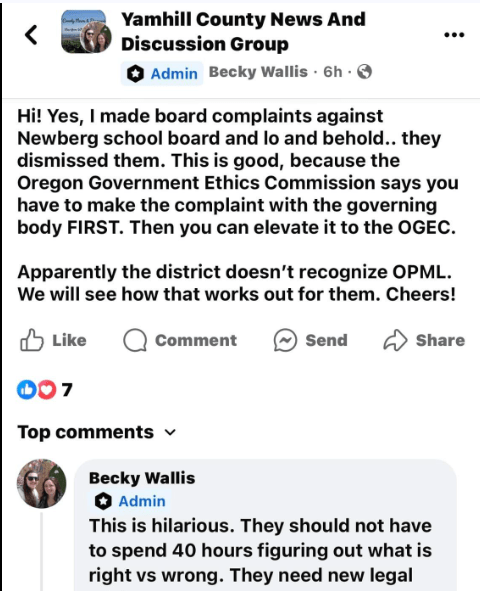
We want to take a moment to point out the end result of Wallis’ multiple complaints to the Newberg School Board. Confident wrongness that cost the district (and therefore the taxpayers) time and money. Board member Nancy Woodward and Finance Committee chair Kat McNeil spent countless hours responding to the complaints. One of the board lawyers also gave hours of time. Becky herself seemed to take pleasure in the time and money she caused the district to waste.
On Friday, November 1, all three complaints that made it to the Oregon Ethics Commission were dismissed. All of Wallis’s complaints were protective of Dr. Phillips, insisting that the board and the chair of the finance committee were breaking the law by hiring an interim superintendent and pointing out financial issues, respectively. Confident wrongness at work.
We have the opportunity to put this kind of partisan politics behind us. We need politicians that are knowledgeable and skilled, not blinded by purity partisan politics. We need politicians willing to work with ALL citizens of Yamhill County for the common good.







 Newberg Neighbors for a Better Community
You must be logged in to post a comment.